cndc

Antitrust: Competition Authority Sanctions Wheat Flour Cartel 150 150 Estudio Trevisan

Antitrust: Competition Authority Sanctions Wheat Flour Cartel

Harina

Through Resolution 332/2022, of April 1, 2022 -published today in the Official Gazette-, the Secretary of Internal Trade (SCI), following CNDC’s Opinion IF-2022-26154360-APN-CNDC# MDP dated March 18, 2022, resolved “to declare responsible the firm MOLINO CAÑUELAS S.A.C.I.F.I.A., the FEDERACIÓN ARGENTINA DE LA INDUSTRIA MOLINERA, CÁMARA DE INDUSTRIALES MOLINEROS and ASOCIACIÓN PEQUEÑAS Y MEDIANAS INDUSTRIAS MOLINERAS DE LA REPÚBLICA ARGENTINA, for executing a concerted horizontal practice of setting minimum prices and exchanging sensitive information in the wheat milling market and the marketing of wheat flour throughout the national territory, affecting the general economic interest, violating the provisions of Section 1 of Law No. 27,442, specifically subsections a) of Section 2 and a) of Section 3 of said regulatory plexus.”

Consequently, the SCI resolved:

(i) Impose (i) on the firm MOLINO CAÑUELAS S.A.C.I.F.I.A., a fine in the amount of AR$150,000,000; (ii) to the FEDERACIÓN ARGENTINA DE LA INDUSTRIA MOLINERA, a fine in the amount of $150,000,000; (iii) to the CÁMARA DE INDUSTRIALES MOLINEROS a fine in the amount of $93,974,602; and (iv) the ASOCIACIÓN PEQUEÑAS Y MEDIANAS INDUSTRIAS MOLINERAS DE LA REPÚBLICA ARGENTINA, a fine in the amount of $51,131,995; in accordance with the provisions of Section 46 of Law 25,156;

(ii) Order said entities to cease and refrain from entering into price-fixing agreements and exchanging sensitive information in the wheat milling market and the marketing of wheat flour; Y

(iii) Order the FEDERACIÓN ARGENTINA DE LA INDUSTRIA MOLINERA, the CÁMARA DE INDUSTRIALES MOLINEROS and the ASOCIACIÓN PEQUEÑAS Y MEDIANAS INDUSTRIAS MOLINERAS DE LA REPÚBLICA ARGENTINA to publish the «Guide on Defense of Competition for Business Associations and Chambers and Professional Associations and Associations ” published on the website of the NATIONAL COMMISSION FOR THE DEFENSE OF COMPETITION in their respective web domains or in the one they use from time to time.

Among the recitals of Resolution 332/2022, it is highlighted that:

(A) Due to the analysis carried out by the CNDC, it was concluded that the GENERAL AGREEMENT FOR THE DEFENSE OF FREE COMPETITION IN THE MILLING SECTOR (document that was denounced by the firm IMPULSAR (INDUSTRIAS MEDIANAS Y PEQUEÑAS UNIDAS LOCALES SOCIEDAD ARGENTINA) in its complaint to the CNDC dated April 4, 2017): “(i) it was conceived, designed, implemented and monitored by the milling entities, the FEDERACIÓN ARGENTINA DE LA INDUSTRIA MOLINERA, the CÁMARA DE INDUSTRIALES MOLINEROS and the ASOCIACIÓN PEQUEÑAS Y MEDIANAS INDUSTRIAS MOLINERAS DE LA REPÚBLICA ARGENTINA and the firm MOLINO CAÑUELAS S.A.C.I.F.I.A.; (ii) was signed by at least ONE HUNDRED SEVEN (107) milling companies on August 13, 2015 at the SHERATON HOTEL; (iii) had an auditing system in place to monitor compliance; (iv) established a system of sanctions for non-compliance; and (v) the expected reference cost was calculated at the request of the FEDERACIÓN ARGENTINA DE LA INDUSTRIA MOLINERA, through the signing of an agreement with a university institution”; and

(B) Said GENERAL AGREEMENT FOR THE DEFENSE OF FREE COMPETITION IN THE MILLING SECTOR sets up a horizontal collusive practice between the defendants, for setting minimum sales prices and exchanging sensitive information, in order to limit competition between milling companies in the wheat milling market and the commercialization of wheat flour throughout the national territory, being detrimental to free competition and the general economic interest.

Private Enforcement – Damages: It is important to highlight, that in accordance with Section 62 of Law 27,442, «individuals or legal entities affected by acts prohibited by this law, may bring an action for reparation of damages in accordance with the norms of civil law, before the competent judge in that matter.»

Source: https://www.boletinoficial.gob.ar/detalleAviso/primera/260423/20220405
Derecho de la Competencia: Importante Sanción por Cartelización en Mercado de Harina de Trigo 150 150 Estudio Trevisan

Derecho de la Competencia: Importante Sanción por Cartelización en Mercado de Harina de Trigo

Harina

Mediante la Resolución 332/2022, del 1 de abril de 2022 -publicada en el día de la fecha en el Boletín Oficial-, la Secretaría de Comercio Interior (SCI), haciendo propio el Dictamen IF-2022-26154360-APN-CNDC#MDP de fecha 18 de marzo de 2022, de la Comisión Nacional de Defensa de la Competencia (CNDC), resolvió “declarar responsables a la firma MOLINO CAÑUELAS S.A.C.I.F.I.A., a la FEDERACIÓN ARGENTINA DE LA INDUSTRIA MOLINERA, a la CÁMARA DE INDUSTRIALES MOLINEROS y a la ASOCIACIÓN PEQUEÑAS Y MEDIANAS INDUSTRIAS MOLINERAS DE LA REPÚBLICA ARGENTINA, por ejecutar una práctica horizontal concertada de fijación de precios mínimos e intercambio de información sensible en el mercado de la molienda de trigo y la comercialización de harina de trigo en todo el territorio nacional, con afectación al interés económico general, infringiendo lo dispuesto en el Artículo 1° de la Ley N° 27.442, específicamente en los incisos a) del Artículo 2° y a) del Artículo 3° de dicho plexo normativo”.

En consecuencia, el SCI resolvió:

(i)              Imponer (i) a la firma MOLINO CAÑUELAS S.A.C.I.F.I.A., una multa por la suma de $150.000.000; (ii) a la FEDERACIÓN ARGENTINA DE LA INDUSTRIA MOLINERA, una multa por la suma de $ 150.000.000; (iii) a la CÁMARA DE INDUSTRIALES MOLINEROS una multa por la suma de $93.974.602; y (iv) a la ASOCIACIÓN PEQUEÑAS Y MEDIANAS INDUSTRIAS MOLINERAS DE LA REPÚBLICA ARGENTINA, una multa por la suma de $51.131.995; de conformidad con lo dispuesto en el Artículo 46 de la Ley 25.156;

(ii)            Ordenar a dichas entidades que cesen y se abstengan de realizar acuerdos de fijación de precios e intercambiar información sensible, en el mercado de la molienda de trigo y la comercialización de harina de trigo; y

(iii)           Ordenar la FEDERACIÓN ARGENTINA DE LA INDUSTRIA MOLINERA, a la CÁMARA DE INDUSTRIALES MOLINEROS y a la ASOCIACIÓN PEQUEÑAS Y MEDIANAS INDUSTRIAS MOLINERAS DE LA REPÚBLICA ARGENTINA que publiquen la “Guía sobre Defensa de la Competencia para Asociaciones y Cámaras Empresariales y Colegios y Asociaciones Profesionales” publicada en el sitio web de la COMISIÓN NACIONAL DE DEFENSA DE LA COMPETENCIA en sus respectivos dominios web o en el que utilicen oportunamente.

Entre los considerandos de la Resolución 332/2022 se destaca que:

(A) En razón del análisis  efectuado por la CNDC, se concluyó que el ACUERDO GENERAL DE DEFENSA DE LA LIBRE COMPETENCIA EN EL SECTOR MOLINERO (documento que fuera denunciado por la firma IMPULSAR (INDUSTRIAS MEDIANAS Y PEQUEÑAS UNIDAS LOCALES SOCIEDAD ARGENTINA) Simple Asociación en su denuncia ante la CNDC de fecha 4 de abril de 2017): “(i) fue ideado, diseñado, implementado y monitoreado por las entidades molineras, FEDERACIÓN ARGENTINA DE LA INDUSTRIA MOLINERA, CÁMARA DE INDUSTRIALES MOLINEROS y ASOCIACIÓN PEQUEÑAS Y MEDIANAS INDUSTRIAS MOLINERAS DE LA REPÚBLICA ARGENTINA, y la firma MOLINO CAÑUELAS S.A.C.I.F.I.A.; (ii) fue suscripto al menos por CIENTO SIETE (107) empresas molineras el día 13 de agosto de 2015 en el HOTEL SHERATON; (iii) contó con un sistema de auditorías con el objetivo de monitorear su cumplimiento; (iv) estableció un sistema de sanciones por incumplimiento; y (v) el costo de referencia previsto fue calculado a pedido de la FEDERACIÓN ARGENTINA DE LA INDUSTRIA MOLINERA, mediante la suscripción de un convenio con una institución universitaria”; y

(B) Dicho ACUERDO GENERAL DE DEFENSA DE LA LIBRE COMPETENCIA EN EL SECTOR MOLINERO configura una práctica colusiva horizontal entre las imputadas, para la fijación de precios mínimos de venta e intercambio de información sensible, con el objeto de limitar la competencia entre las empresas molineras en el mercado de la molienda de trigo y la comercialización de harina de trigo en todo el territorio nacional, resultando perjudicial para la libre competencia y el interés económico general.

De la reparación de daños y perjuicios. Se recuerda que, conforme a lo dispuesto por el artículo 62 de la Ley 27.442, “las personas humanas o jurídicas damnificadas por los actos prohibidos por esta ley, podrán ejercer la acción de reparación de daños y perjuicios conforme las normas del derecho común, ante el juez competente en esa materia”.

Fuente: https://www.boletinoficial.gob.ar/detalleAviso/primera/260423/20220405
COVID-19: Reporte 03/2020 150 150 admin

COVID-19: Reporte 03/2020

Secretaría de Comercio Interior – Defensa de la Competencia y Defensa del Consumidor.

Mediante la Resolución 98/2020 de la Secretaría de Comercio Interior (SCI), publicada en el día de la fecha en el Boletín Oficial, se suspenden todos los plazos procedimentales y/o procesales en todos los expedientes en trámite por las Leyes 19.511, 22.802, 24.240, 25.156, 26.993, y 27.442, sus normas modificatorias y complementarias, y el Decreto N° 274/19, «por el período comprendido desde el día 16 de marzo de 2020 y hasta el día 31 de marzo de 2020, ambas fechas inclusive».

Asimismo, entre otras medidas, por mismo período, se limita únicamente a la atención de los asuntos de urgente despacho, se desafecta Mesa de Entradas de la Comisión Nacional de Defensa de la Competencia (CNDC), la cual será reemplazada por la Mesa General de Entradas del Ministerio de Desarrollo Productivo y se suspende la celebración de audiencias en el ámbito de la Dirección de Servicio del COPREC.

Además, hace saber que se aplicará la Ley de Abastecimiento 20.680, «a todo aquel cuya acción ponga en riesgo la protección del bienestar común del Pueblo Argentino».

CNDC: Report on Competition Conditions in the Medicines Market 150 150 admin

CNDC: Report on Competition Conditions in the Medicines Market

I. Introduction

The Comisión Nacional de Defensa de la Competencia (National Commission for the Defense of Competition, or the CNDC, for its Spanish acronym) published on December 23rd, 2019, a technical report that summarizes the results of a series of market studies carried out since 2017 on the conditions of competition in the pharmaceutical industry, with the aim to know the conditions of competition, especially, regarding the chain of distribution of drugs and the vertical and/or corporate integration between laboratories and pharmaceutical distributors and/or drug wholesalers.

For these purposes, information was required and hearings were held with different agents in the sector (laboratories, drug wholesalers, pharmaceutical distributors, public bodies, experts, etc.).

The same report describes the relevant aspects of the pharmaceutical market in Argentina from the point of view of Argentine Competition Law No. 27,442 (LDC), focusing particularly on the wholesale stage of distribution. An analysis of sales to the institutional channel is not included in the work, which represents approximately 24% of total sales.

The report has as background a complaint filed in the middle of 2012 by Farmacity against different actors in the pharmaceutical market (including centrally to laboratories and their three business chambers), and a penalty imposed at the request of the Antitrust Authority against a series of entities that bring together all the pharmacies in the province of Tucumán for the realization of a collusive horizontal practice.

This is a description of the status of the situation, which concludes CNDC’s investigation, and which does not raise behaviors to be investigated and/or recommended actions, notwithstanding that the CNDC itself states that it is expected that the pharmaceutical industry be at the center of the agenda of the competition enforcement authority.

Previously, at the beginning of 2014, the CNDC had initiated various ex officio investigations of markets that were considered as relevant (including medicine drugs for human consumption). This, concomitantly with the price controls carried out then by the Secretary of Commerce and the Price Information Regimes established by Resolution No. 29/2014 and regulated by Provision 6/2014 of the Secretary of Commerce of the Ministry of Economy and Public Finance, and according to the then applicable Information Regime of Joint Resolution No. 66/2014 and No. 3629/2014 of the Secretary of Commerce and the Federal Administration of Public Revenue (Argentine Tax Authority, AFIP), respectively. The number assigned to this file (C. 1486) corresponds to a conduct investigation, within which we have not been aware of any complaint or record that the file has been closed.

The following is a summary of the most relevant points of CNDC’s report, on which we are fully available to expand specifically if deemed convenient.

II. The value chain in the pharmaceutical industry in Argentina

The value chain of the pharmaceutical industry comprises the stages of: (i) research and development, (ii) commercial production; (iii) wholesale distribution; and (iv) retail marketing.

II.I. Research and development (R&D)

Research consists in the recognition of new molecules associated with properties of regulation of biological processes that allow the treatment of certain disease or pathology. The research phase concludes with toxicological studies and pharmacokinetic analysis. Upon completion of the investigation, the development of the drug requires a series of pre-clinical and clinical studies and then to be approved by the corresponding health authority.

R&D is a strongly regulated activity in terms of the possibility of commercial launch and dependent on the rate of innovations. There is a relatively small group of multinational capital laboratories that sell medicines in the country, which carry out R&D under the protection of a patent. These laboratories usually carry out intense marketing activities in order to position their products. On the other hand, there are local companies that produce medicines with expired patents.

The innovation activities of national laboratories are primarily aimed at the manufacture of new products based on known drugs and with expired patents. In the country there are 18 companies with national capital that elaborate and/or commercialize biotechnological medicinal specialties.

II.II Commercial production

Around 350 laboratories operate in Argentina. The majority are national companies with industrial plants based in the country, which have a greater presence in outpatient medications. Foreign laboratories lead the high-cost drug segment. There are also 40 state laboratories, with an estimated low market share.

The Argentine laboratories are grouped into four chambers: CAEMe (mostly multinationals), CILFA (medium and large Argentine labs), COOPERALA (smaller Argentine labs) and CAPGEN (small generic producers).

Without counting high-cost medicines, the 20 most important laboratories in the country account for 70% of total sales. None of them have a share of more than 10%. Although the industry concentration level appears to be low, the analysis of the whole pharmaceutical market requires disaggregation up to levels 3 or 4 (therapeutic class) of the ATC (Anatomical Therapeutic Classification).

Nearly half of the relevant markets are highly concentrated. Regarding high-cost medicines, a high concentration of supply is recorded in a small number of pathologies and drugs. For most active ingredients, there is only one offering laboratory.

The main laboratories participate indirectly in the subsequent stages of the chain (wholesale distribution and commercialization), through corporate links with pharmaceutical distributors, drug wholesalers and mandatary or managing companies.

II.III Distribution

Pharmaceutical distributors and drug wholesalers are involved in this stage. In Argentina, the “buy-sell” and “delivery by logistics operator” (fee for service) systems coexist in addition. Medical visitors and pharmaceutical visitors, also participate.

Pharmaceutical distributors emerged in the 1990s as a result of a strategy of larger laboratories aimed at reducing distribution costs and inventories. 81% of the turnover of drugs sold in pharmacies is concentrated in 4 pharmaceutical distributors, which have as main shareholders national and foreign laboratories and have about 100 laboratories as clients (30% of the total).

Each laboratory uses a single distributor, but not a single drug wholesaler. It is the laboratory that chooses the distributor with which it operates, while the pharmacies are the ones that choose the drug wholesaler with which they operate. At an international level, the growing trend is the direct sales modality from laboratories to pharmacies, as well as models of reduced wholesale intermediation.

Drug wholesalers have a wide retail reach and play a very important role in areas with large numbers of stores or located in dispersed geographical spaces, with low population density. There are integral drug wholesalers and specialized drug wholesalers (they distribute exclusively high-cost medicines, grouped in CADDE). The integrals are grouped in ADEM, while the three largest together represent 60% of the turnover of integral drug wholesalers. Most laboratories do not have participation in large integral drug wholesalers. The specialized drug wholesalers do not have links with the laboratories.

II.IV Retail Marketing

There are about 12,700 pharmacies throughout the country, which are supplied byore than one drug wholesaler. There are also two types of pharmacies: single or family, and branches or franchises. During the last decade, there has been a great growth of networks or chains of pharmacies.

II.V Mandatary companies

Mandatary or managing companies are entities in charge of administering and auditing contracts or agreements for outpatient medicine and non-ambulatory drug benefits between laboratories and public healthcare service organizations, prepaid healthcare companies, hospitals and other agencies linked to the health system. The most important are Farmalink and Preserfar.

PAMI eliminated the intermediation of Farmalink. Since November 1, 2018, this activity is carried out by PAMI itself through the FARMAPAMI system. In March 2018, a joint purchase was made between several institutions that allowed the price reduction (high-cost medicines).

III. Prices

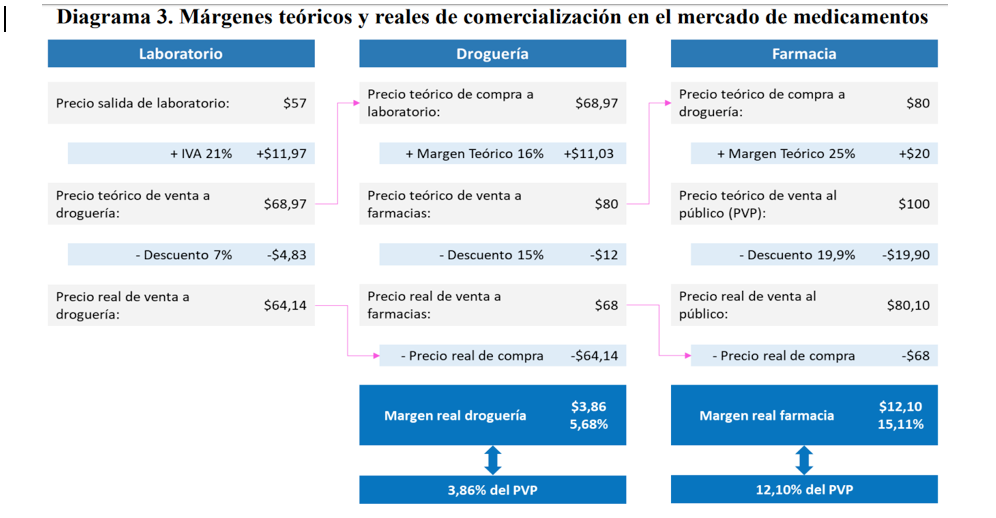
It is argued that the laboratories are the ones who set the prices along the chain, including the retail price (PVP). In the case of high-cost medicines, the participation of laboratories in price formation is more direct. The configuration of the price and margin system can have consequences that distort competition.

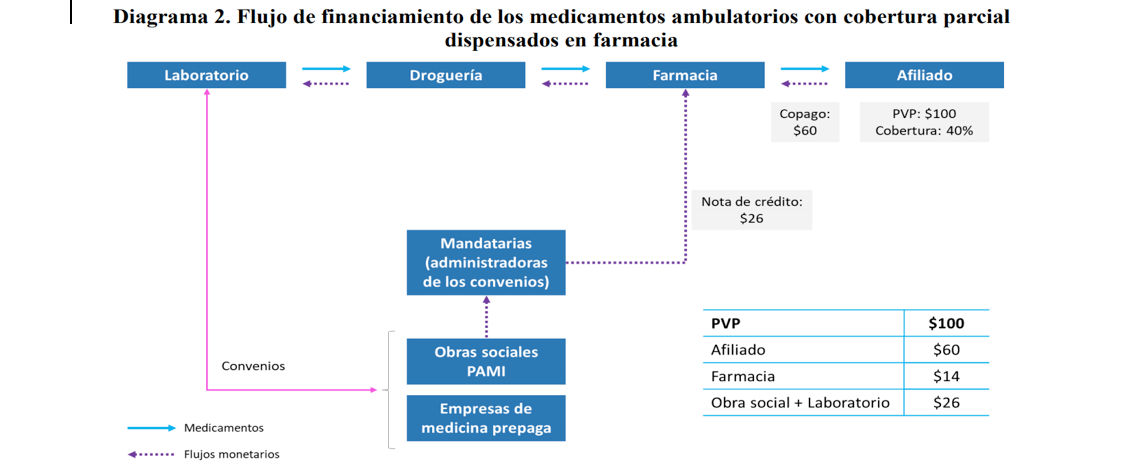
The operation of the settlement system of the agreements by the agents for outpatient medicines works, in broad strokes, as follows: The discount on drugs that the patient receives from part of the public healthcare service organization or prepaid healthcare companies (generally, 40% of the PVP, although in some cases, such as in the case of chronic diseases, it may be higher), health insurance covers between 10% and 15% of the PVP (according to the agreement with the manufacturing laboratory) and the rest is absorbed between the laboratory and the pharmacy. The agents are responsible for liquidating the discount of public healthcare service organizations and prepaid healthcare companies. The process begins when the patient acquires the medication and receives the corresponding discount. Then the pharmacist sends the die with the prescription and the patient’s signature to the agent, which validates the prescription and issues a credit note for the percentage of the discount that corresponds to the public healthcare service organizations or prepaid healthcare companies and to the laboratory, so that they can validate it. The pharmacist uses the credit note (with payment terms of up to 60 days) to cancel debt with the drug wholesaler. The latter uses the credit note to cancel debt with the laboratory. The laboratory accepts the credit note as a form of payment and then receives part of the discount applied by the public healthcare service organizations and prepaid healthcare companies. Diagram 2 illustrates this process.

 Screen Shot 2020-03-10 at 6.23.56 PM

Source: CNDC’s Report

Screen Shot 2020-03-10 at 6.30.29 PM

Source: CNDC’s Report

IV. Synthesis and conclusions

The analysis of all the information collected by the CNDC in the framework of the refered investigation allowed the Authority to arrive at a series of considerations:

  1. In the first place, the emergence of pharmaceutical distributors has its origin in saving logistics costs for laboratories. At an international level, there is a growing trend towards this type of commercialization whereby wholesale marketing is carried out through agents that act on consignment, charging only for logistics, without having ownership of the inventory. In Argentina, pharmaceutical distributors have not replaced drug wholesalers, but have joined as another link in the chain. The activity of the pharmaceutical distributors, as providers of logistics services, presents high barriers to entry because it is an activity with strong economies of scale and the need to make high investments to meet the standards that are required to participate in the market. Given these characteristics, at that stage a small number of firms that distribute the entire portfolio of drugs operate: outpatient medicine, non-ambulatory and high cost. Most laboratories would not be significantly unable to switch between pharmaceutical distributors or sell directly to drug wholesalers, without resorting to the services of pharmaceutical distributors. The capital stock of each of the four largest pharmaceutical distributors, is owned (directly or indirectly) by the largest laboratories. The sum of the shares of these laboratories in the total industry is 37.7%. Therefore, these pharmaceutical distributors mostly distribute unrelated third party medications. Shareholdings may give laboratories access to competition information that is not otherwise available in the market, which could facilitate anticompetitive practices. However, pharmaceutical distributors have stated that there are high standards of confidentiality of the information in each laboratory, and these standards are reflected in the pharmaceutical distributors’ contracts with their customers. In fact, laboratories distribute only through a distributor.
  2. Secondly, within the framework of the investigation it has been observed that there are two very different types of drug wholesalers: the integral and the specialized ones. Integral drug wholesalers market the vast majority of medicinal specialties and laboratories in the market. Specialized drug wholesalers exclusively distribute high-cost medications. The market of integral drug wholesalers is concentrated in three drug wholesalers that together represent around 60% of the total turnover of the segment of integral drug wholesalers: Droguería del Sud, Droguería Monroe Americana and Droguería Suizo Argentina. The presence of shareholder laboratories (directly or indirectly) is lower in drug wholesalers than in the case of pharmaceutical distributors. In relation to the specialized drug wholesalers that distribute high-cost medicines, there would be no corporate participation of any laboratory. It has been observed that, in general, pharmacies stock up on more than one drug wholesaler for their daily business. The large integral drug wholesalers coexist with others of smaller size and regional presence, some with relevant participation in the areas where they distribute. Among the latter, the presence of cooperatives stands out, which in many cases are made up of pharmacies or pharmacy chains and appear to be a way of aggregating the demand of pharmacies.
  3. Third, it has been observed that although laboratories do not have significant corporate interests in drug wholesalers and no participation in pharmacies, they have the ability to set the retail price (PVP) of medicines, which seems to be the result of the agreements for dispensing medications with the different social security entities, which in general include the conditions under which the distribution and dispensing of the drugs included in the agreements is made. In their operation, these agreements include a mechanism to reimburse pharmacies through credit notes that, in fact, reduce their purchase alternatives and may produce some loyalty of pharmacies in relation to certain products. For all the preceding factors, it is concluded that the possibility that drug wholesalers or pharmacies may offer lower prices than those established by laboratories or generic drugs is very small. In the case of substitution for generic drugs, bioequivalence studies are particularly relevant in the cases in which they proceed.

Finally, the CNDC concludes by holding: “Given the particular conditions of competition in which the pharmaceutical industry operates in Argentina and the importance from the sanitary point of view that the population may have due access to the necessary medicines, and following the practice of competition authorities in countries with more extensive experience, it is expected that the pharmaceutical industry will continue to be at the center of the agenda of the competition enforcement authority”.

In our opinion, this report is the starting point to describe and analyze the reality of the production, distribution and marketing of medicines in Argentina, identifying the different actors -some of which are arranged or required by regulation and others have been created due to the local dynamics, like intermediaries and agents- but it does not advance, however, in the analysis of the effects or conditions that this structure has generated.

In this sense, the system implemented in fact, consciously or not, seems to allow vertical concentration, generating a favorable context for the exchange of sensitive information. At the same time, the sales power seems to be concentrated from top to bottom, using unregulated intermediaries (pharmaceutical distributors and agents), while pharmacies would remain atomized. We note that this report has not referred to the concentration that seems to be also happening between medical insurance entities and health centers.

The work also does not advance on the analysis of certain observed practices; for example: price publicity, pricing system and margins; system of reimbursements through credit notes and in the counterweight exercised or that could be exercised by social security entities and prepaid healthcare companies in the formation of the retail price of outpatient medicines as a result of their purchasing power.

Consequently, under this analysis, no objections from the CNDC have been given to the general structure of the market for medicines that support the opening of behavioral investigations or additional conditions for concentration processes.