Company Law

Incentive Regime for Large Investments (RIGI) 150 150 Estudio Trevisan

Incentive Regime for Large Investments (RIGI)

Business people shaking hands together

1. Large Investment Incentive Regime (RIGI):

Law No. 27,742, in its article 164, introduces the RIGI, which offers key incentives to legal vehicles that manage investment projects that meet the criteria established by law. This regime seeks to provide certainty, legal security, and an efficient system of protection of acquired rights, with the aim of encouraging large investments and guaranteeing the economic prosperity of the country.

2. Main Objectives of RIGI:

RIGI’s priority objectives include:

  • Promote large national and foreign investments for the economic development and prosperity of the country.
  • Strengthen the competitiveness of various economic sectors and increase exports.
  • Create jobs and ensure conditions of predictability and stability for large investments.
  • Promote collaboration between the National State and the provinces, as well as the development of local production chains.

3. Single Project Vehicles (VPU):

In accordance with article 169 of the law, Single Project Vehicles (VPU) can join the RIGI, which must be dedicated exclusively to a single investment project. These vehicles must not carry out activities or possess assets not related to the project, except for temporary working capital investments.

4. Dedicated Branches:

Article 170 of Law No. 27,742 allows the creation of Dedicated Branches to manage activities not directly linked to the investment project. These branches must comply with specific requirements, such as registration in the public registry, obtaining a Unique Tax Identification Code (CUIT), and separate accounting from the parent company.

5. Regulations of Decree No. 749/2024:

Decree No. 749/2024 regulates aspects related to Dedicated Branches, establishing additional requirements, such as capital accreditation and accounting separation. The procedures for registering these branches must follow the regulations stipulated in the decree.

The assigned capital can be in pesos or dollars, and must be accredited with the corresponding documents. The assets and liabilities used must be strictly linked to the investment project registered under the RIGI, preventing them from being mixed with other activities of the parent company.

Companies that take advantage of this regime will enjoy guaranteed legal protection, protected against possible non-compliance by the State and benefited from a particular tax regime that promotes long-term investments.

Dedicated Branches must comply with their own tax obligation, separate from the parent company, which ensures greater clarity in their financial transactions. In addition, it is necessary to obtain a Unique Tax Identification Code (CUIT) and register for the taxes relevant to the activities carried out by the company.

6. Requirements for the Registration of Dedicated Branches:

Companies and branches that wish to establish a Dedicated Branch in the Autonomous City of Buenos Aires must present key documentation, including:

Present testimony of a public deed or original private instrument that contains the decision to open the branch for the purposes of joining the RIGI and that contains:

  • The headquarters of the Dedicated or Special branch.
  • Designation of representative in charge who expressly accepts the position and establishes domicile within CABA.
  • Amount of capital assigned for the investment project.
  • Description of the unique object of the investment project.
  • Accounting opinion issued by a Public Accountant, issued on the affected assets assigned to the capital.
  • Present authentic proof of registration in the Public Registry corresponding to your jurisdiction, which certifies the validity of the social registration. Failing that, the professional prequalification opinion must state that the author has verified said point, reporting the registration data with the Public Registry of the jurisdiction in which the company to which the dedicated or Special Branch belongs is registered.

7. Declaration of non-distortion of the local market:

The application for joining the RIGI must contain, in addition to the investment plan and the requirements established by art. 47, a sworn declaration of non-distortion of the local market and a technical study, through which an analysis of the positive and negative effects that the projected investment could have among the actors of the relevant market must be presented, under warning of rejection in limine.

The Enforcement Authority may give intervention to the National Commission for the Defense of Competition to issue a non-binding opinion.

Without prejudice to this, it is expressly ratified that joining the RIGI does not exempt compliance with Law No. 27,442 on the Defense of Competition.

8. Modifications and Cancellation:

Companies may modify or cancel the registration of the Dedicated Branch after the completion of the project or by decision not to continue with it. Foreign branches have the option of becoming branches according to Law No. 19,550.

9. Invitation to Replicate:

A call is made to the provincial Public Registries to replicate the established procedures and regulations, facilitating the implementation of the RIGI at the national level and thus promoting investments in large-scale projects that add value to the Argentine economy.

10. Conclusions:

The Large Investment Incentive Regime (RIGI), established by Law No. 27,742, represents a significant measure to attract and secure large investments, both national and foreign, in the Argentine Republic. Through this legal framework, the possibilities of attracting both national and foreign capital are enabled, offering an environment of certainty and legal security, in order to stimulate economic development, job creation and strengthening competitiveness in various sectors. .

Key aspects of the RIGI include the need for Single Project Vehicles (SPV) to be dedicated exclusively to specific investment projects, and the introduction of a mechanism for the creation of Dedicated Branches. These branches must comply with rigorous requirements, such as separate accounting and capital accreditation, to ensure that assets and liabilities are effectively allocated to the investment project.

Companies covered by the regime could enjoy solid legal protection, which would guarantee respect for their acquired rights and protect them against possible non-compliance by the State. Together with the planned tax benefits, the RIGI would emerge as an attractive instrument to encourage long-term investments.

An aspect that is relevant is the requirement to present an affidavit of non-distortion of the local market, accompanied by a technical analysis of the effects of the investment in the relevant market. This mechanism would help ensure that investments, in addition to promoting development, do not generate adverse impacts on competition.

In short, the RIGI is presented as a strategic opportunity for large investors, offering a robust legal framework guaranteeing stability, transparency and state support, thus promoting growth and productive development in Argentina.

Furthermore, if the provinces decided to replicate its implementation, this regime could facilitate the expansion of large-scale investments throughout the national territory, contributing to more equitable economic development.

CNDC: Report on Competition Conditions in the Medicines Market 150 150 admin

CNDC: Report on Competition Conditions in the Medicines Market

I. Introduction

The Comisión Nacional de Defensa de la Competencia (National Commission for the Defense of Competition, or the CNDC, for its Spanish acronym) published on December 23rd, 2019, a technical report that summarizes the results of a series of market studies carried out since 2017 on the conditions of competition in the pharmaceutical industry, with the aim to know the conditions of competition, especially, regarding the chain of distribution of drugs and the vertical and/or corporate integration between laboratories and pharmaceutical distributors and/or drug wholesalers.

For these purposes, information was required and hearings were held with different agents in the sector (laboratories, drug wholesalers, pharmaceutical distributors, public bodies, experts, etc.).

The same report describes the relevant aspects of the pharmaceutical market in Argentina from the point of view of Argentine Competition Law No. 27,442 (LDC), focusing particularly on the wholesale stage of distribution. An analysis of sales to the institutional channel is not included in the work, which represents approximately 24% of total sales.

The report has as background a complaint filed in the middle of 2012 by Farmacity against different actors in the pharmaceutical market (including centrally to laboratories and their three business chambers), and a penalty imposed at the request of the Antitrust Authority against a series of entities that bring together all the pharmacies in the province of Tucumán for the realization of a collusive horizontal practice.

This is a description of the status of the situation, which concludes CNDC’s investigation, and which does not raise behaviors to be investigated and/or recommended actions, notwithstanding that the CNDC itself states that it is expected that the pharmaceutical industry be at the center of the agenda of the competition enforcement authority.

Previously, at the beginning of 2014, the CNDC had initiated various ex officio investigations of markets that were considered as relevant (including medicine drugs for human consumption). This, concomitantly with the price controls carried out then by the Secretary of Commerce and the Price Information Regimes established by Resolution No. 29/2014 and regulated by Provision 6/2014 of the Secretary of Commerce of the Ministry of Economy and Public Finance, and according to the then applicable Information Regime of Joint Resolution No. 66/2014 and No. 3629/2014 of the Secretary of Commerce and the Federal Administration of Public Revenue (Argentine Tax Authority, AFIP), respectively. The number assigned to this file (C. 1486) corresponds to a conduct investigation, within which we have not been aware of any complaint or record that the file has been closed.

The following is a summary of the most relevant points of CNDC’s report, on which we are fully available to expand specifically if deemed convenient.

II. The value chain in the pharmaceutical industry in Argentina

The value chain of the pharmaceutical industry comprises the stages of: (i) research and development, (ii) commercial production; (iii) wholesale distribution; and (iv) retail marketing.

II.I. Research and development (R&D)

Research consists in the recognition of new molecules associated with properties of regulation of biological processes that allow the treatment of certain disease or pathology. The research phase concludes with toxicological studies and pharmacokinetic analysis. Upon completion of the investigation, the development of the drug requires a series of pre-clinical and clinical studies and then to be approved by the corresponding health authority.

R&D is a strongly regulated activity in terms of the possibility of commercial launch and dependent on the rate of innovations. There is a relatively small group of multinational capital laboratories that sell medicines in the country, which carry out R&D under the protection of a patent. These laboratories usually carry out intense marketing activities in order to position their products. On the other hand, there are local companies that produce medicines with expired patents.

The innovation activities of national laboratories are primarily aimed at the manufacture of new products based on known drugs and with expired patents. In the country there are 18 companies with national capital that elaborate and/or commercialize biotechnological medicinal specialties.

II.II Commercial production

Around 350 laboratories operate in Argentina. The majority are national companies with industrial plants based in the country, which have a greater presence in outpatient medications. Foreign laboratories lead the high-cost drug segment. There are also 40 state laboratories, with an estimated low market share.

The Argentine laboratories are grouped into four chambers: CAEMe (mostly multinationals), CILFA (medium and large Argentine labs), COOPERALA (smaller Argentine labs) and CAPGEN (small generic producers).

Without counting high-cost medicines, the 20 most important laboratories in the country account for 70% of total sales. None of them have a share of more than 10%. Although the industry concentration level appears to be low, the analysis of the whole pharmaceutical market requires disaggregation up to levels 3 or 4 (therapeutic class) of the ATC (Anatomical Therapeutic Classification).

Nearly half of the relevant markets are highly concentrated. Regarding high-cost medicines, a high concentration of supply is recorded in a small number of pathologies and drugs. For most active ingredients, there is only one offering laboratory.

The main laboratories participate indirectly in the subsequent stages of the chain (wholesale distribution and commercialization), through corporate links with pharmaceutical distributors, drug wholesalers and mandatary or managing companies.

II.III Distribution

Pharmaceutical distributors and drug wholesalers are involved in this stage. In Argentina, the “buy-sell” and “delivery by logistics operator” (fee for service) systems coexist in addition. Medical visitors and pharmaceutical visitors, also participate.

Pharmaceutical distributors emerged in the 1990s as a result of a strategy of larger laboratories aimed at reducing distribution costs and inventories. 81% of the turnover of drugs sold in pharmacies is concentrated in 4 pharmaceutical distributors, which have as main shareholders national and foreign laboratories and have about 100 laboratories as clients (30% of the total).

Each laboratory uses a single distributor, but not a single drug wholesaler. It is the laboratory that chooses the distributor with which it operates, while the pharmacies are the ones that choose the drug wholesaler with which they operate. At an international level, the growing trend is the direct sales modality from laboratories to pharmacies, as well as models of reduced wholesale intermediation.

Drug wholesalers have a wide retail reach and play a very important role in areas with large numbers of stores or located in dispersed geographical spaces, with low population density. There are integral drug wholesalers and specialized drug wholesalers (they distribute exclusively high-cost medicines, grouped in CADDE). The integrals are grouped in ADEM, while the three largest together represent 60% of the turnover of integral drug wholesalers. Most laboratories do not have participation in large integral drug wholesalers. The specialized drug wholesalers do not have links with the laboratories.

II.IV Retail Marketing

There are about 12,700 pharmacies throughout the country, which are supplied byore than one drug wholesaler. There are also two types of pharmacies: single or family, and branches or franchises. During the last decade, there has been a great growth of networks or chains of pharmacies.

II.V Mandatary companies

Mandatary or managing companies are entities in charge of administering and auditing contracts or agreements for outpatient medicine and non-ambulatory drug benefits between laboratories and public healthcare service organizations, prepaid healthcare companies, hospitals and other agencies linked to the health system. The most important are Farmalink and Preserfar.

PAMI eliminated the intermediation of Farmalink. Since November 1, 2018, this activity is carried out by PAMI itself through the FARMAPAMI system. In March 2018, a joint purchase was made between several institutions that allowed the price reduction (high-cost medicines).

III. Prices

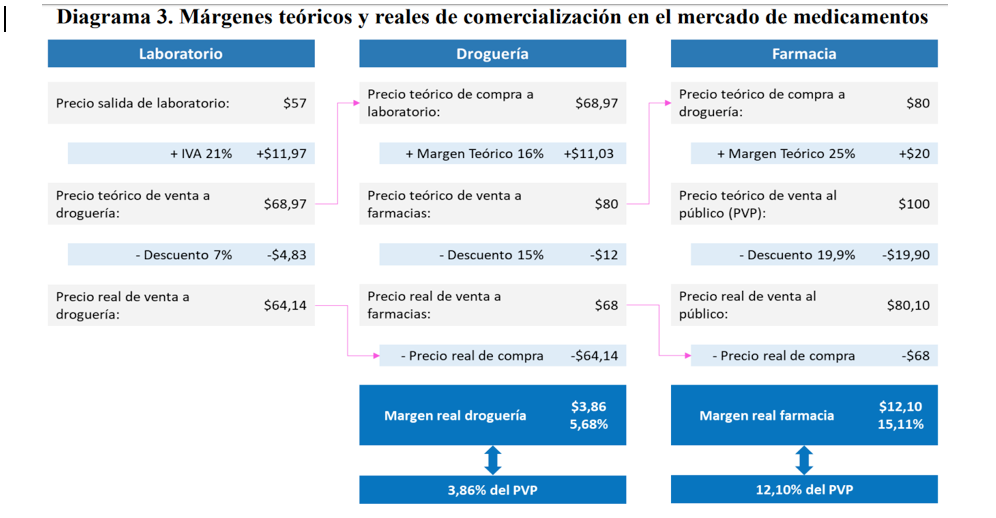
It is argued that the laboratories are the ones who set the prices along the chain, including the retail price (PVP). In the case of high-cost medicines, the participation of laboratories in price formation is more direct. The configuration of the price and margin system can have consequences that distort competition.

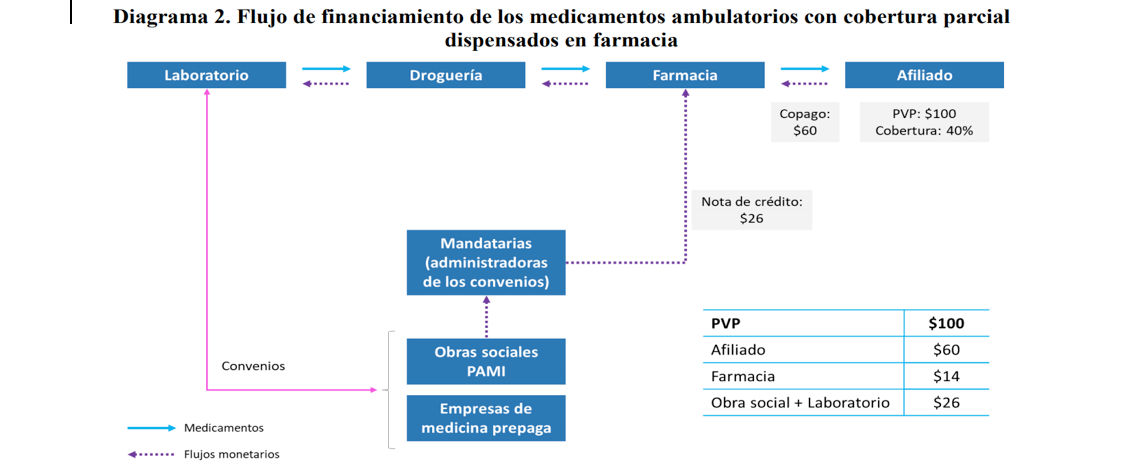
The operation of the settlement system of the agreements by the agents for outpatient medicines works, in broad strokes, as follows: The discount on drugs that the patient receives from part of the public healthcare service organization or prepaid healthcare companies (generally, 40% of the PVP, although in some cases, such as in the case of chronic diseases, it may be higher), health insurance covers between 10% and 15% of the PVP (according to the agreement with the manufacturing laboratory) and the rest is absorbed between the laboratory and the pharmacy. The agents are responsible for liquidating the discount of public healthcare service organizations and prepaid healthcare companies. The process begins when the patient acquires the medication and receives the corresponding discount. Then the pharmacist sends the die with the prescription and the patient’s signature to the agent, which validates the prescription and issues a credit note for the percentage of the discount that corresponds to the public healthcare service organizations or prepaid healthcare companies and to the laboratory, so that they can validate it. The pharmacist uses the credit note (with payment terms of up to 60 days) to cancel debt with the drug wholesaler. The latter uses the credit note to cancel debt with the laboratory. The laboratory accepts the credit note as a form of payment and then receives part of the discount applied by the public healthcare service organizations and prepaid healthcare companies. Diagram 2 illustrates this process.

 Screen Shot 2020-03-10 at 6.23.56 PM

Source: CNDC’s Report

Screen Shot 2020-03-10 at 6.30.29 PM

Source: CNDC’s Report

IV. Synthesis and conclusions

The analysis of all the information collected by the CNDC in the framework of the refered investigation allowed the Authority to arrive at a series of considerations:

  1. In the first place, the emergence of pharmaceutical distributors has its origin in saving logistics costs for laboratories. At an international level, there is a growing trend towards this type of commercialization whereby wholesale marketing is carried out through agents that act on consignment, charging only for logistics, without having ownership of the inventory. In Argentina, pharmaceutical distributors have not replaced drug wholesalers, but have joined as another link in the chain. The activity of the pharmaceutical distributors, as providers of logistics services, presents high barriers to entry because it is an activity with strong economies of scale and the need to make high investments to meet the standards that are required to participate in the market. Given these characteristics, at that stage a small number of firms that distribute the entire portfolio of drugs operate: outpatient medicine, non-ambulatory and high cost. Most laboratories would not be significantly unable to switch between pharmaceutical distributors or sell directly to drug wholesalers, without resorting to the services of pharmaceutical distributors. The capital stock of each of the four largest pharmaceutical distributors, is owned (directly or indirectly) by the largest laboratories. The sum of the shares of these laboratories in the total industry is 37.7%. Therefore, these pharmaceutical distributors mostly distribute unrelated third party medications. Shareholdings may give laboratories access to competition information that is not otherwise available in the market, which could facilitate anticompetitive practices. However, pharmaceutical distributors have stated that there are high standards of confidentiality of the information in each laboratory, and these standards are reflected in the pharmaceutical distributors’ contracts with their customers. In fact, laboratories distribute only through a distributor.
  2. Secondly, within the framework of the investigation it has been observed that there are two very different types of drug wholesalers: the integral and the specialized ones. Integral drug wholesalers market the vast majority of medicinal specialties and laboratories in the market. Specialized drug wholesalers exclusively distribute high-cost medications. The market of integral drug wholesalers is concentrated in three drug wholesalers that together represent around 60% of the total turnover of the segment of integral drug wholesalers: Droguería del Sud, Droguería Monroe Americana and Droguería Suizo Argentina. The presence of shareholder laboratories (directly or indirectly) is lower in drug wholesalers than in the case of pharmaceutical distributors. In relation to the specialized drug wholesalers that distribute high-cost medicines, there would be no corporate participation of any laboratory. It has been observed that, in general, pharmacies stock up on more than one drug wholesaler for their daily business. The large integral drug wholesalers coexist with others of smaller size and regional presence, some with relevant participation in the areas where they distribute. Among the latter, the presence of cooperatives stands out, which in many cases are made up of pharmacies or pharmacy chains and appear to be a way of aggregating the demand of pharmacies.
  3. Third, it has been observed that although laboratories do not have significant corporate interests in drug wholesalers and no participation in pharmacies, they have the ability to set the retail price (PVP) of medicines, which seems to be the result of the agreements for dispensing medications with the different social security entities, which in general include the conditions under which the distribution and dispensing of the drugs included in the agreements is made. In their operation, these agreements include a mechanism to reimburse pharmacies through credit notes that, in fact, reduce their purchase alternatives and may produce some loyalty of pharmacies in relation to certain products. For all the preceding factors, it is concluded that the possibility that drug wholesalers or pharmacies may offer lower prices than those established by laboratories or generic drugs is very small. In the case of substitution for generic drugs, bioequivalence studies are particularly relevant in the cases in which they proceed.

Finally, the CNDC concludes by holding: “Given the particular conditions of competition in which the pharmaceutical industry operates in Argentina and the importance from the sanitary point of view that the population may have due access to the necessary medicines, and following the practice of competition authorities in countries with more extensive experience, it is expected that the pharmaceutical industry will continue to be at the center of the agenda of the competition enforcement authority”.

In our opinion, this report is the starting point to describe and analyze the reality of the production, distribution and marketing of medicines in Argentina, identifying the different actors -some of which are arranged or required by regulation and others have been created due to the local dynamics, like intermediaries and agents- but it does not advance, however, in the analysis of the effects or conditions that this structure has generated.

In this sense, the system implemented in fact, consciously or not, seems to allow vertical concentration, generating a favorable context for the exchange of sensitive information. At the same time, the sales power seems to be concentrated from top to bottom, using unregulated intermediaries (pharmaceutical distributors and agents), while pharmacies would remain atomized. We note that this report has not referred to the concentration that seems to be also happening between medical insurance entities and health centers.

The work also does not advance on the analysis of certain observed practices; for example: price publicity, pricing system and margins; system of reimbursements through credit notes and in the counterweight exercised or that could be exercised by social security entities and prepaid healthcare companies in the formation of the retail price of outpatient medicines as a result of their purchasing power.

Consequently, under this analysis, no objections from the CNDC have been given to the general structure of the market for medicines that support the opening of behavioral investigations or additional conditions for concentration processes.

Reforms to the Supply, Consumer Protection and Competition Acts 150 150 admin

Reforms to the Supply, Consumer Protection and Competition Acts

The purpose of this set of laws, as stated in the message sent to Congress at the time of submitting the Bill for consideration, is to avoid abuses and protect the general interest of the population by securing their basic or essential needs.

We will now outline some important elements of the new system.


SUPPLY ACT

Supply Act No. 20680 was originally enacted on July 20, 1974 and, notwithstanding enforcement thereof by the Argentine Executive (including, without limitation, the dispute with Shell, with farm owners and with laboratories – Resolution SC SC 90/2014), its constitutionality was contested by most legal scholars.

The grounds for the rejection of the enforcement of the Supply Act lied in two issues:

(a) The vesting of powers contained in the Supply Act constitutes a delegation of legislative authority upon the Argentine Executive and its instrumentalities. Since the Supply Act ultimately involves the regulation of the right to engage in any lawful business -guaranteed under Article 14 of the Argentine Constitution-, such regulation may only be valid through “laws regulating the exercise of such right”, i.e, such regulation may only occur through formal laws enacted by the Argentine Congress.

Taking into account that the delegation of legislative powers contained therein did not provide for a term for exercise thereof, such delegation was subject to the provisions of provisional Article 8 of the Argentine Constitution, whereby “any delegation of pre-existing legislative powers not providing for a specified term for exercise thereof shall be forfeited upon five years following the effective date of this provision, except for such delegations as expressly ratified by the Argentine Congress under a new law.”

The Argentine Congress ratified on a provisional basis several delegation laws, the last one being Law No. 26519, for a term of one year as from August 24, 2009. Thus, since there was no further legislative ratification, on August 24, 2010, the legislative delegation lapsed, as that contained in the Supply Act.

(b) The Supply Act was also contested under Executive Order No. 2284/91 on Economic Deregulation, as ratified by the Argentine Congress under Law No. 24307.

In this respect, Section 29 thereof provides that “the reinforcement of economic freedom, the deregulation and the creation of a real popular market economy has no sympathy for the existence of certain powers conferred upon the Argentine Executive by the so called Supply Act, which are incompatible with such principles and, in addition, introduce elements of legal insecurity” to suspend Subsection (a) of Section 2 of the Supply Act.

In fact, Executive Order No. 2284/91, as effective under the Argentine Legal Digest, approved by Law No. 26939, provides that the exercise of the powers granted by Law No. 20680 is suspended, which powers may only be reinstated, for the purpose of exercising any and all remedies contained therein, subject to a declaration of supply emergency by the Argentine Congress, whether at general, sectorial or regional level.

Notwithstanding the foregoing, the powers granted under Section 2, Subsection (c), are excluded from the provisions of the preceding paragraph, in which case, the rules on procedures, remedies and statutes of limitations contained in such Law shall remain in full force and effect.

Hence, the Secretariat of Trade relied on the foregoing for the purpose of passing Resolution SC 90/2014, with a reference solely to Subsection (c) of Section 2 of the Supply Act, which mandated to roll back prices to May 7, 2014 and to suspend any increase for a term of 60 days.

The new regulation serves as a first step to solving the existing legal uncertainty and to ratifying full effectiveness of the Supply Act. If enforced, the defenses concerning its illegality or invalidity shall be difficult to sustain because it has been confirmed by the Argentine Congress.

Additionally, it introduces other issues that are outlined hereinbelow:

  1. The application of the regulation is extended to all economic activities (including recreational and non-profit activities) and to all economic processes related to goods and services at every stage of the economic activity. On the other hand, the previous wording limited the jurisdiction to “any purchase, sale, exchange and lease of personal property, works and services” satisfying, directly or indirectly, the common or ordinary needs of the population. In turn, economic players considered as small-sized or medium-sized companies are excluded.
  2. The powers contained in Sections 2 & 3 of the original bill are reinstated, and thus, the enforcement authority may:
  • Establish, for any stage of the economic process, profit margins, reference prices, price ceilings and floors, or any or all of the foregoing;
  • Lay down regulations governing marketing, brokerage, distribution and/or production;
  • Provide for the continuity in the production, industrialization, marketing, transportation, distribution or provision of services, as well as in the manufacturing of certain products, within such minimum levels as established by the enforcement authority, for the purposes of which, the enforcement authority shall take into account the usual volume of production, manufacturing, sales or provision of service and the productive capacity, financial position of the liable party and economic equation of the process or activity.
  • In such case, an evaluation shall be made to ascertain whether the continuity in the production, industrialization, marketing, transportation, distribution or provision of services, as well as in the manufacturing of certain products, is economically feasible; otherwise, the enforcement authority shall impose a reasonable and adequate compensation.
  • Request information about the sale prices of the goods or services produced and rendered, as well as about availability thereof for sale;
  • Demand the filing of all kinds of books, documents, mail, business records and any other element related to the management of the businesses; conduct technical experts’ examinations.
  • Confiscate, if necessary, all of the aforementioned elements, for a maximum term of thirty (30) business days;
  • Create the records and provide for the keeping of such special books as established;
  • Establish business licenses systems.
  • The penalties have a new ceiling of $10 million, which may be doubled in the event of a second offense.
  • Companies must first pay the penalty and then file an appeal before the Courts, if they wish to do so;
  • Imprisonment is removed as penalty for offenders;
  • The business may be closed down for a term of up to 90 days;
  • Any infringing goods and products may be confiscated;
  • Special disqualification for up to five (5) years for commerce and public offices;
  • Suspension for up to five (5) years in the Government’s registries of suppliers;
  • Loss of concessions, privileges, and special tax or credit programs.
  1. In the event it is estimated that, as a result of the foregoing, a financial loss is sustained, a partial or total review of the actions taken may be requested but doing so shall not excuse specific performance of the obligations so imposed, as long as no decision is made in connection with such petition, which resolution shall be rendered within fifteen (15) business days following such claim.
  2. The Governors of the Provinces and/or the Head of Government of the City of Buenos Aires, by themselves or through their designees, may set —within their respective jurisdictions— maximum prices and the relevant supplementary actions referred to above as long as the Argentine Executive does not do so.
  3. As regards penalties:
  • The penalties have a new ceiling of AR$10 million, which may be doubled in the event of a second offense.
  • Companies must first pay the penalty and then file an appeal before the Courts, if they wish to do so;
  • Imprisonment is removed as penalty for offenders;
  • The business may be closed down for a term of up to 90 days;
  • Any infringing goods and products may be confiscated;
  • Special disqualification for up to five (5) years to conduct business and hold public offices;
  • Suspension for up to five (5) years in the Government’s registries of suppliers;
  1. Loss of concessions, privileges, and special tax or credit programs. The application of penalties may be against companies and their officers involved in the commission of the infringing events, to the extent acting with willful misconduct or gross negligence (they all used to be deemed liable in the past, whether or not they had been involved).
  2. Section 14 provides that any confiscated goods may be sold, leased or shipped if perishable and/or supply thereof is insufficient, for the purposes of which no prior deposit or expropriation proceedings shall be required.
  3. No entity is appointed as enforcement authority; the Argentine Executive shall appoint one.
  4. A 3-year statute of limitations is set, the running of which shall be interrupted by the commission of new violations or the filing of administrative or legal actions.
  5. When faced by a shortage of goods or services that satisfy basic or essential needs related to the general welfare of the population, the enforcement authority may order, under a duly grounded resolution, their, sale, production, distribution or provision in the entire territory of the Republic of Argentina, irrespective of the owner thereof and, upon failure to fulfill such requirement, the relevant penalties shall be imposed. Such decision may last as long as required for remedying such shortage situation.
  6. The possibility to close down the business, as a preventive measure, for up to three (3) days during the inspection procedures is maintained. This decision may be extended to up to thirty (30) days, even though such extension requires prior court approval.
  7. The terms to assert defenses before the administrative authorities and to file a direct appeal against the resolutions imposing such penalties are extended, in both cases, from five (5) to ten (10) business days.
  8. The jurisdiction of the Criminal Courts of Original Jurisdiction is removed and jurisdiction is granted to the Federal Court of Appeals in Administrative Matters and to the Federal Courts of Appeals of the Argentine provinces, depending upon the location of the administrative authority involved, for reviewing the resolutions imposing penalties.
  9. As a requirement to appeal the imposition of a penalty, the amount of the fine must be previously deposited, unless such deposit may cause irreparable harm to the appellant. Thus, the possibility of replacing the amount of the fine with a bond or a security over the goodwill, as provided for under the previous Supply Act, is also removed.
  10. The Administrative Proceedings Act No. 19549 shall be subsidiarily applied, instead of the Code of Criminal Proceedings.


CONSUMER PROTECTION:

Significant changes are introduced with respect to the dispute resolution system on consumer protection matters, which will now consist of three stages:

1. Preliminary Settlement Service in Consumer Relations (“COPREC”, for its Spanish acronym)

The first stage of this proposal creates COPREC, which shall be involved in all individual right claims concerning consumer relations (resulting from the Consumer Protection Act) up to a maximum amount of 55 minimum salaries (currently, AR$ 198,000) and shall be the mandatory step prior to bringing a lawsuit before the Federal Courts in Consumer Relations -to be created-. COPREC shall depend upon the Secretariat of Trade, which shall be the enforcement authority and act at national level.

COPREC shall coexist with the consumer protection agencies of the City of Buenos Aires in the Management and Participation Centers.

The procedure shall be free of charge and shall serve to bring the parties closer to reach an agreement.

2. Audit in Consumer Relations

The procedure is commenced once the requirement in 1 above has been met without having reached an agreement or due to the reported company’s failure to appear. The parties may be represented by legal counsel and the consumer may be assisted by such representatives as specifically listed under the Consumer Protection Act.

This Auditor in Consumer Relations must be an attorney, pursuant to the requirements contained in the regulations in force, and shall participate in the dispute concerning the liability for the damages caused to the consumer as a result of the risk or defect of the item and for direct damages (Sections 40 & 40 bis of the Consumer Protection Act) for up to an amount equivalent to 15 minimum salaries (currently, AR$ 54,000).

This system shall depend upon the Argentine Ministry of Economy and Public Finance, which is an independent authority, and the procedure shall be of an administrative nature.

Upon receipt of the consumer’s claim, the parties shall be summoned to a hearing, where the evidence offered shall be produced. The Auditor shall verify, on an ex officio basis, the material truth of the facts in order to subsequently render a resolution within not more than 5 days following the hearing.

If the disputed facts are outside the Auditor’s scope of expertise due to their complexity, more comprehensive proceedings may be undertaken to decide the legal issue, with the possibility of bringing an action before the Federal Courts in Consumer Relations.

The resolution shall be subject to appeal, with representation by legal counsel, before the Federal Court of Appeals in Consumer Relations or before the appropriate Federal Court of Appeals in the Argentine provinces.

3. Federal Courts in Consumer Relations

A new venue is created that will have jurisdiction to hear cases related to consumer relations under the Consumer Protection Act and any other rule governing this type of relations. This venue shall have jurisdiction as long as the claim does not exceed an amount equivalent to 55 times a minimum salary. If such ceiling is exceeded, an action may be filed before the ordinary courts (lower courts in Civil or Commercial matters).

In this respect, eight courts of original jurisdiction and two divisions of a Court of Appeals in Consumer Relations are created, all of them located in Capital Federal.

The procedure may not exceed sixty days and shall observe the following procedural rules: (i) jointly with the complaint and answer to the complaint, all evidence shall be offered (there will be no written interrogatories and only three witness per party shall be admitted); (ii) no motions that must be previously decided, peremptory challenges or counterclaims may be filed; (iii) the terms to answer the complaint, file grounded appeals and answer the appellate brief shall be five days and all other terms shall be three days; (iv) the hearings shall be public and the judge will attempt to settle the case and, if no agreement is reached, all evidence shall be produced and a decision shall be rendered; (v) only such resolutions as granting or dismissing injunctive relief, and final court decisions, shall be appealable (as long as not exceeding five minimum salaries – currently, AR$ 18,000); and (vi) all payments to be made to the consumer shall be made by payment into court under the penalty of invalidity ab initio.

It should be noted that within this stage the judge may grant punitive damages disregarding the limit set for claims, i.e. 55 times the minimum salary.

If the amount of the penalty exceeds the five salaries minimum, the parties may appeal the decision before the Federal Court of Appeals in Consumer Relations.


ANTITRUST

The set of laws contained in Bill No. 1250 includes an amendment to Law No. 25156. The amendments in the field of Antitrust are solely related to behaviors, with business combinations remaining unchanged, except with respect to the courts having jurisdiction over appeals.

The major modifications are as follows:

  1. No Independent Court:

The Antitrust Court was intended to be an independent authority on the matter, as provided for under Law No. 25156. In practice, it was never created, which was described by the Supreme Court of Justice of the Republic of Argentina as a legal scandal. During the past few years, the duties of the Antitrust Court were fulfilled by the Argentine Competition Commission (CNDC, for its Spanish acronym) and the Secretariat of Trade, who ruled and decided, respectively, on all antitrust matters. Now, under the new law, the Secretary of Trade is officially replacing the Antitrust Court and undertaking the duties that had been assigned to the latter. CNDC will continue to exist as a technical body dependant upon the Secretariat of Trade.

  1. New venue designated for appeals:

Another important modification is the participation of the Federal Court in Consumer Relations in these matters. This new venue will be in charge of solving disputes arising in connection with consumer protection, fair trade and antitrust issues.

  1. Solve et repete:

The effect resulting from sustaining appeals is modified. Till now, Section 52 of Law No. 25156 provided that, in the event of a penalty, appeals were granted with staying effects. The new system provides that, in the event of a penalty, the appellant shall deposit the amount of the fine prior to filing the appeal and, upon failure to do so, the appeal will be dismissed, unless doing so may cause irreparable harm to the appellant.

  1. New applicable regulations

The new regulations provide that the criminal rules (the Criminal Code and the Code of Criminal Proceedings) shall be replaced by the Administrative Proceedings Act No. 19549, for any cases not provided by law.

Getting the Deal Through – Mergers & Acquisitions 2014 150 150 admin

Getting the Deal Through – Mergers & Acquisitions 2014

GTDT National expert red

Reproduced with permission from Law Business Research Ltd. This article was first published in Getting the Deal Through – Mergers & Acquisitions 2014, (published in May 2014; contributing editor: Alan M Klein, Simpson Thacher & Bartlett LLP). For further information please visit www.GettingTheDealThrough.com

To access full content, please click on the following link:

2014 M&A – Argentina

Considerations Regarding the Exception Under Section 10, Subsection (e) of Law No. 25,156 150 150 admin

Considerations Regarding the Exception Under Section 10, Subsection (e) of Law No. 25,156

Introduction

The final exception under Section 10, Subsection (e), which provides as follows: “Business combination transactions provided under Section 6 requiring notice, as provided for under Section 8, where the transaction amount and value of the assets located in the Republic of Argentina to be merged, acquired, transferred or controlled do not exceed, individually, ARGENTINE PESOS TWENTY MILLION (AR$ 20,000,000), unless within the past twelve months there have been transactions exceeding, in the aggregate, such amount, or ARGENTINE PESOS SIXTY MILLION (AR$ 60,000,000) within the past thirty-six months, as long as in both cases such transactions occur within the same market. (Subsection incorporated by Article 3 of Executive Order No. 396/2001, published on the Argentine Official Gazette on 04/05/2001.- Effective 04/09/2001)”.

Review

This exception, contained in Section 10, Subsection (e) of the Antitrust Law, has been incorporated into the Antitrust Law by Executive Order No. 396/2001, Article 3, effective April 9, 2001, and has not been subject to clarifications or subsequently supplemented.

Such Section 10, Subsection (e), applies whenever the amount of the transaction involved and the value of the assets to be merged, acquired or transferred, both in connection with Argentina, do not exceed, individually, AR$ 20,000,000. That is to say, if just one of any such elements exceeds the threshold prescribed by law, the transaction will not fall within the scope of the exception and thus, shall be subject to notification.

In this respect, Advisory Opinion No. 203 has considered: “for the exception to apply, both the amount of the transaction involved and the value of the assets to be merged, acquired or transferred in Argentina shall be taken into account”, expressly referring to the considerations made in previous Advisory Opinions (No. 163, 159 and 187, among others).

But, how should such elements be valued and what should be taken into account?

1. On the one hand, the assets have been defined as “all such assets as permitting the conduction of one or several activities, which, in addition, may be attributed an independent turnover, each with their own clients and values originated in the possibility of generating business affairs” (Advisory Opinion No. 131).

2. On the other hand, in order to value the amount allocated to the transaction in Argentina, the following guidelines have been considered: (1) the amount reported in the agreement between the parties; (ii) the overall transaction amount and the amount disclosed by the notifying parties in the advisory opinion application or file; and (iii) any direct or indirect imports that may be defined as substantial, usual and foreseeable. We understand that all these guidelines are analyzed by Comisión Nacional de Defensa de la Competencia (Argentine Antitrust Authority, hereinafter referred to as “CNDC”) throughout the procedure, considering the local effects of the transaction, irrespective of the impact of such transaction upon the local general economic interest (Advisory Opinion No. 1016, which expressly states that such impact is only relevant for the purposes of the resolution under Section 13 of Law No. 25156).

With respect to (iii) above related to imports, CNDC has held in several opportunities that in order to determine whether any transaction executed by a person that conducts business outside the Republic of Argentina has an impact upon the Argentine domestic market, the substantial, usual and foreseeable nature of the imports involved should be assessed (see Advisory Opinions No. 44, 52, 64, 65, 68, 99 bis and 211, among others). Therefore, as therein noted “if the local sales of the company involved are insignificant, they will not generate substantial local effects” (Advisory Opinions No. 52 and 68, among others), and “any agreement or contract between companies conducting business outside Argentina the impact of which upon the Argentine domestic market is harmless will obviously not be subject to local laws” (Advisory Opinion No. 4). In connection with the foregoing, certain international rules require that the effects should be direct, substantial and reasonably foreseeable (see Section 7 of the Foreign Trade Antitrust Improvements Act, which amended the Sherman Act). Accordingly, the European Union has held that, in these cases, the existence of direct, substantial and foreseeable effects must be ascertained (Gencor Ltd. c/ Commission of the European Communities, Case T-102/96 dated March 25, 1999).” (Advisory Opinion No. 899/2011).

Recently, CNDC has decided on another transaction performed abroad and, following the relevant analysis, it was able to also conclude that the existence of substantial, usual and foreseeable imports led to believe that the transaction under review had effects in Argentina and, therefore, was subject to notification, without the exception being applicable (Advisory Opinion No. 1016).

This means that CNDC will take into account, in principle, the frequency of the imports made during the past 3 years, the existence of distribution or business cooperation agreements, and whether such agreements contain exclusivity provisions, the amount of such imports, among other aspects. This information will very likely be required during the review procedure for the purpose of the analysis conducted by CNDC. And if the circumstances described in each case so permit, CNDC will understand that, for the purposes of the analysis of such case, imports shall be taken into account because they generate effects in the Republic of Argentina, as provided under Section 3 of the Antitrust Law.

3. Finally, consideration should be given to the final part of the same paragraph since it provides for certain counter-exceptions. These attempt to exclude staggered or successive mergers carried out in the same market within not more than 36 months from the exception.

Conclusions

Given the universality of business transactions and the transnational effects of trade, this exception is key to determining whether any one transaction (in principle, outside Argentina) is subject to the notification requirement contained in Section 8 of the Antitrust Law in Argentina.

For such purpose, the assets to be merged, acquired or transferred in Argentina as well as the price allocated to the transaction in Argentina should be valued, pursuant to such definitions and guidelines as outlined above. Failure to update the thresholds provided for in the Antitrust Law and the devaluation of the Argentine currency, among other aspects, have contributed to generalizing the obligation to notify in Argentina.

This exception has been recognized in Advisory Opinions No. 126, 127, 131, 134 and 142, all from 2001 (when Subsection (e) was incorporated under Executive Order No. 396/2001), among others.